
The Leiden Declaration
Mathematicians speak out on AI

Earlier this month a group of mathematicians released the Leiden Declaration, a “call to action to address the challenges posed by the use of artificial intelligence within mathematics research.” You can read it yourself here. The name comes from a conference held in September of 2025 at Leiden University, from which a working group was formed that crafted the declaration. It’s essentially an affirmation of long-established norms of the discipline, and a call to action to not let AI disrupt those norms. The authors clearly hope their document will be a model for other disciplines, adding “provisions according to their own values, priorities, and governance.” Unfortunately, while the values of most mathematicians are well-articulated in the declaration, the recommendations made there are more concerned with preserving the culture of mathematics than its values.
To begin, let me say how much I appreciate much of what’s there. For example, the declaration nicely spells out the importance of attribution in the practice of mathematics. A mathematician can spend years of their life proving one theorem. They get no direct rewards for their effort, other than a single line on their vitae. Any real benefits come from secondary effects: a rise in stature in their field, conference invitations, research grants, tenure, promotion, etc. All of those secondary benefits depend on credit being given to the author for their work, often in the form of citations by other authors who build on it. In AI-generated proofs, those citations may be missing. AI model developers absolutely need to address this.
On the other hand, the declaration largely ignores the fact that even the best intentions of AI model developers will still result in a degradation of credit for human-authored proofs. That’s an artifact of another part of the culture of mathematics that is not mentioned in the declaration: citations are only first-order. If a mathematical proof directly relies on some secondary proof, it is customary to cite that work. It is NOT normally the custom to cite all the tertiary work that the secondary proof relied on. Consequently, human authorship may certainly get lost as human results go farther back in the tree of logical dependencies. Presumably, from here on out the number of AI-generated proofs is going to grow faster than those of humans, so the unfortunate truth is that it may be unavoidable that credit for human contributions is going to get diluted. Perhaps the authors of the declaration recognize this issue when they say, “Artificial intelligence may obscure … the collective human labor behind a result.” However, I don’t see how any of their recommendations address this issue.
The preceding quote also indicates a level of discomfort with the idea that AI models are trained on the collective output of generations of human mathematicians. They imply this in other places as well. For example, they state: “Technologies that draw extensively on the published mathematical commons undermine the traditional system of attribution.” Highlighting this as a problem risks adopting a view of mathematics that prioritizes credit to individuals over progress in the field. An alternate viewpoint is that the body of proven mathematical truths is a product of humanity. Leveraging all of that human work to create AI systems that reveal further truths beyond those established by individual humans just advances the totality of human knowledge that much further, and potentially that much faster. The loss of credit to human contributors may just be the price to pay for this kind of progress.
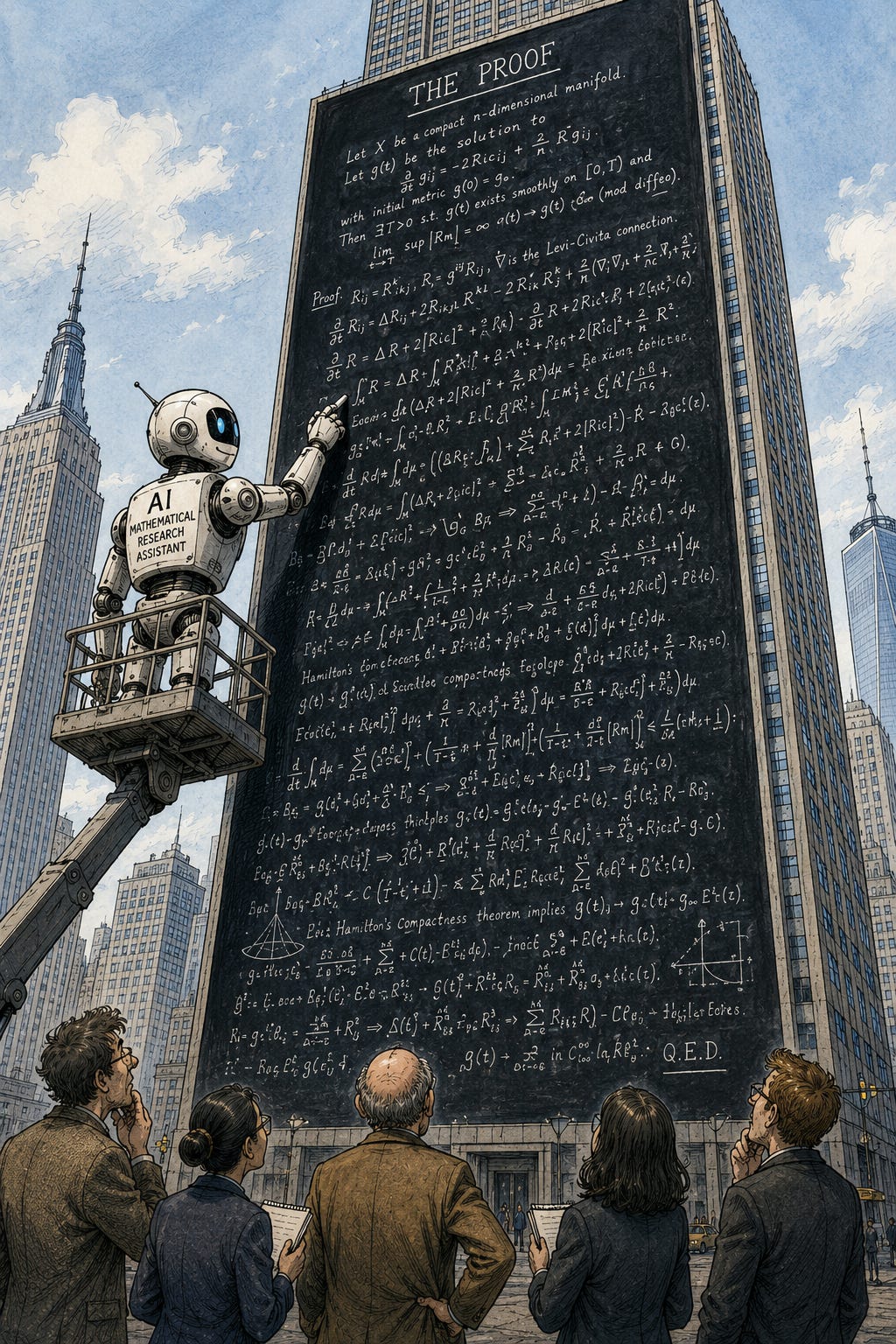
The authors of the declaration express a clear view on this. They state, “consider how preservation of the values articulated in this Declaration may be worth a delay in obtaining results.” That is a position that explicitly prioritizes the human-centered norms of mathematics over the speed of expansion of mathematical knowledge. However, what happens when it’s not just the speed of progress that’s at stake, but progress itself? This is likely to be the central conflict facing the current generation of mathematicians, and the declaration is largely silent on this issue. What happens when machines generate proofs that are simply beyond human comprehension? It is possible, for example, that (given the standard axiomatization of mathematics), a central open conjecture such as the Riemann Hypothesis is true, but its shortest proof is 10 billion lines long. Generating such a proof (and its formal verification) may be within reach of machines, but it would not be readable by any human in their lifetime. The declaration does not address the fundamental questions that will surely arise in these situations. Should we simply reject proofs that no human understands, even if they’ve been formally verified? If not, what role should they play in the development of the field?
While the declaration acknowledges the potential benefits of AI for the discovery of new mathematics, I also find it odd that the authors choose to highlight potential dangers of AI to society without ever mentioning broader positive impacts. For example, in closing the authors state (again), “Some of the resulting general-purpose models are being commercialized for applications that raise grave ethical concerns, including those named earlier: warfare, oppression, mass surveillance, and the undermining of democracy.” AI is a general-purpose technology, and any such technology can be used for purposes that many find unethical. However, the recent conflict between the U.S. Defense Department and Anthropic over the use of their model, Claude, for autonomous weapons and mass surveillance is evidence that the relationship between frontier AI labs and these harmful applications is more complicated than the declaration suggests. At least some model developers are actively resisting precisely the uses mentioned in the declaration.
Ultimately, the recommendations in the declaration are less about preserving mathematical values than about preserving the culture of mathematics. But trying to preserve a culture unchanged in the face of massive technological shifts has usually been a losing battle. Mathematicians would be better off channeling their efforts toward adapting their culture to new realities: developing new forms of recognition for human contributions, new standards for publication and tenure, new expectations for attribution, and new ways of evaluating machine-generated results that may be correct, important, and yet not fully comprehensible by humans.
AI News Bits
The biggest news continues to be that Anthropic’s “Mythos class” public model Fable 5 is still in limbo during safety negotiations with the US government. Meanwhile, OpenAI has released an updated GPT 5.5 Cyber model that they say has comparable benchmarks to Claude Mythos for cybersecurity applications.
This week also saw a host of significant AI talent movement that’s worth paying attention to:
Dean Ball, former White House AI policy advisor, took a position with OpenAI to lead a new Strategic Futures team.
Google VP of engineering and Gemini co-lead Noam Shazeer also went to OpenAI.
John Jumper took a position with Anthropic. Jumper was a senior Google DeepMind researcher, co-creator of AlphaFold, and shared the 2024 Nobel Prize in Chemistry with DeepMind CEO Demis Hassabis.
David Bachman is a professor of Mathematics, Data Science, and Computer Science. He writes about AI and its real-world impacts. To learn more about his academic work, mathematical art, or AI speaking, consulting, and curriculum development, visit davidbachmandesign.com.