
The Great Data Center Debate
Globally, data centers are a manageable environmental problem. Locally, they can be disastrous.

Editorial note: Applications are now open for the “AI-assisted coding for Mathematical Exploration” workshop at the Institute for Computational and Experimental Mathematics, December 11-13, in Providence, RI. Details can be found here.
I was recently chatting with a software engineer who said that whenever he decides whether or not to use AI assistance, he first decides “how many endangered frogs it’s worth boiling for.” While perhaps a callous jest, it was also an earnest expression of awareness that his personal use of AI has real environmental impacts. It’s all too easy to forget that when using AI. Environmental concerns are now at the top of many people’s misgivings with AI. Data centers are the physical manifestation of those concerns, and I’m long overdue for a post about them.

After a significant amount of research, here are the conclusions I’ve come to:
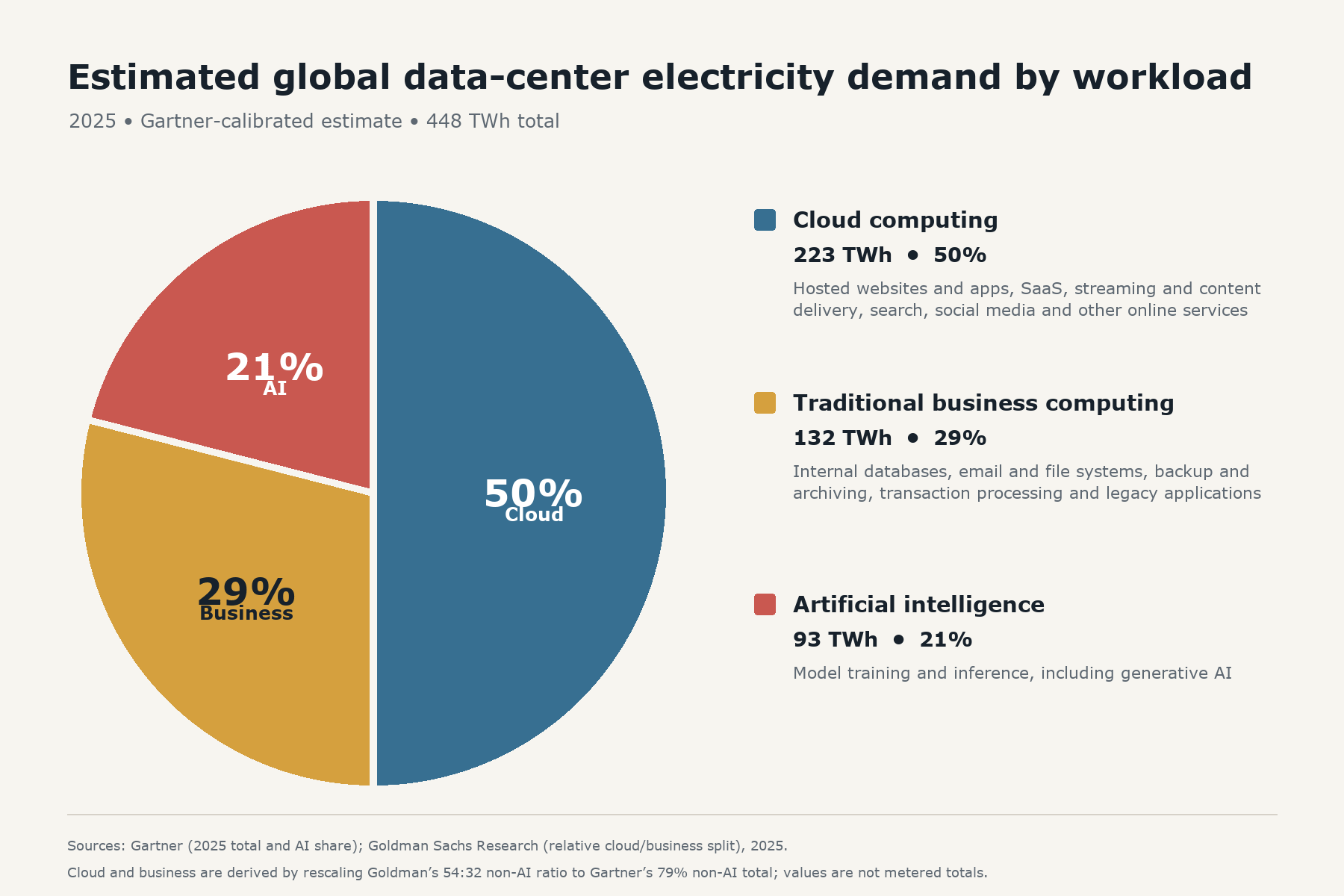
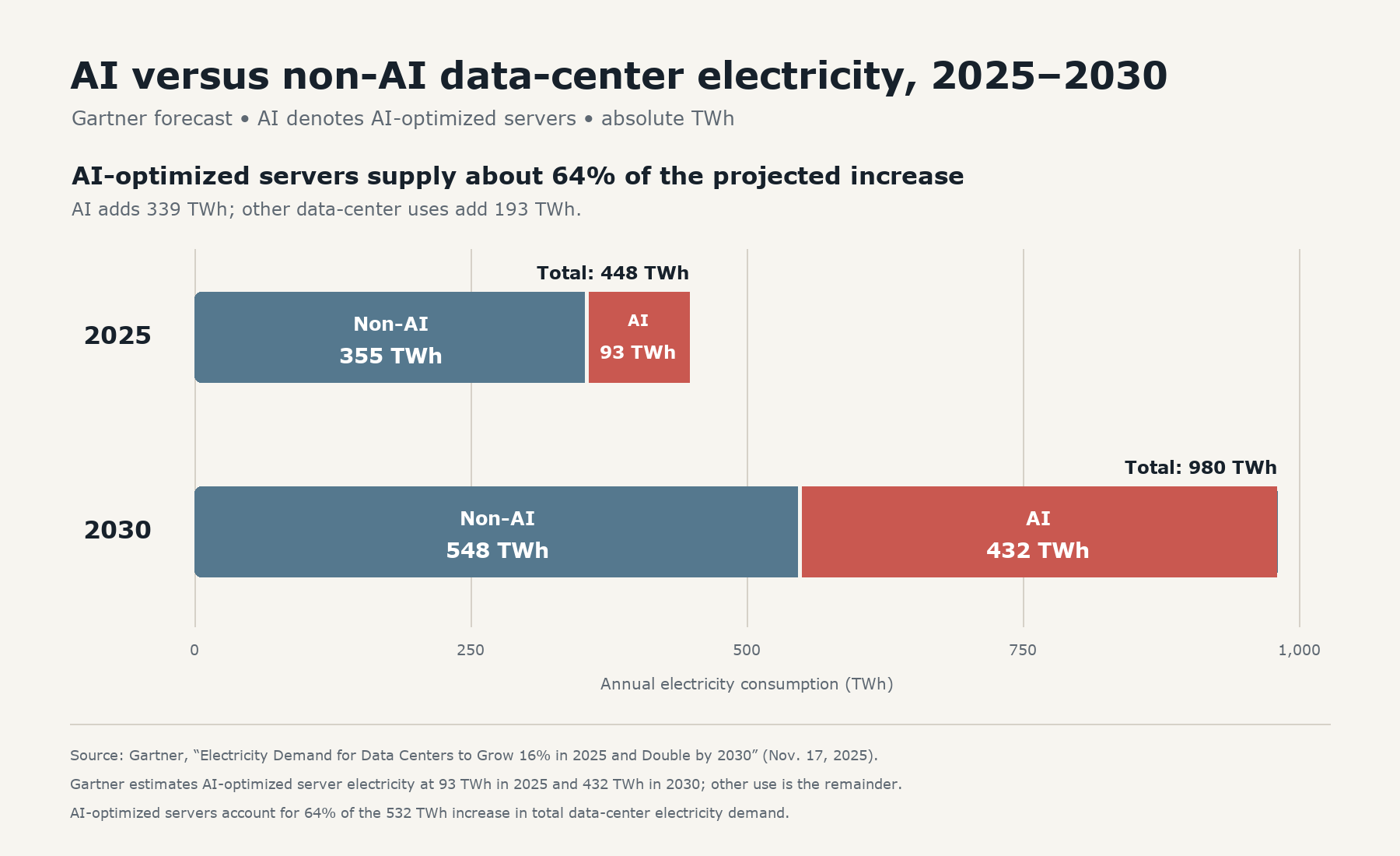
AI accounts for less than a quarter of current data-center use, but the majority of data center growth is due to rising AI demand. [Gartner]
Globally, data centers use relatively small amounts of energy and water compared to other major industries. [IEA][Lawrence Berkeley Labs][USGS]
Just under half of data centers are in highly water-stressed areas, which can cause significant problems for some local communities. As more data centers are built these problems will grow, unless we enact careful regulations. Responsible data center construction is possible. [S&P Global]
With that said, these are all gross oversimplifications! The actual picture is considerably more complicated. Don’t trust anyone, on either side of the debate, who limits their arguments to three bullet points.
AI and Data Centers
While most AI systems physically reside in data centers, data centers do not equal AI. AI currently accounts for only about 21% of data center use. The rest is everything else people do online. This includes personal use (e.g., social media, streaming music and movies, online shopping, etc) as well as professional use (spreadsheets, email, slideshow presentations, data storage and analysis, etc).
With that said, this is projected to change. By 2030 data center energy use is projected to roughly double, and AI’s share of data center demand is projected to rise. The bottom line? The majority (64%) of new data center demand is being driven by AI.
Energy and Water Use
So just how bad are data centers? To some extent, that depends on the scale of your viewpoint. Globally, data centers use a relatively small amount of electricity. In 2024 data centers accounted for about 1.5% of the world’s electricity demand. In 2030 this is projected to rise to 3%. It’s certainly not nothing, but it is dwarfed by industrial motors, air conditioning, electric vehicles, etc.
Data centers also use a lot of water, but again this is relatively small, on a global scale, when compared to other water-hungry industries. Berkeley Labs estimates that U.S. facilities consumed about 17.4 billion gallons directly in 2023. That may sound like a lot, but that amount is consumed by U.S. irrigation in a few hours.
What is more concerning is the impact of data centers on local communities. Just under half of data centers are located in highly water-stressed areas. That doesn’t mean that half of data centers are causing water issues in their local communities, but some communities have documented substantial effects. For example, in The Dalles, Oregon, records released after a 13-month legal fight showed that Google’s data centers consumed 274.5 million gallons of potable water in 2021. That’s more than a quarter of all the water used by the city.
State and national regulators need to carefully assess the impacts on local communities when approving new data center projects, and data center builders need to take every possible precaution to limit those impacts. Individuals can have power, too. In drought-stricken Santiago, Chile, Google’s existing data center consumed just over 100 million gallons annually. After residents opposed a planned second facility, Google agreed to redesign it around air cooling, and an environmental tribunal ordered the company to reconsider the effects of climate change before proceeding.
Local effects are not limited to water or electricity. Virginia auditors found that at least 15 operational data center sites had generated noise that nearby residents considered problematic. Some residents reported migraines, disrupted sleep, difficulty concentrating, and avoiding their yards because of the constant industrial hum. The sound was usually below local noise limits, making the complaints difficult for regulators to address.
It is possible to build data centers in an environmentally responsible way. For example, Virginia also provides good examples of well-managed data center water use. In a 2024 report, state auditors judged that 2023 data center withdrawals were sustainable under Virginia’s source modeling. Most data center buildings there used no more water than an average large office building. Data center water use was under 0.5% of total state withdrawals and just over a third of that water came from reclaimed sources rather than new freshwater withdrawals. (With that said, Virginia officials expressed concerns about growing demands from data centers.)
Complicating factors
A few realities significantly complicate the debate. For example, technological improvements are expected to lead to significantly more computational ability per unit energy. As noted above, some 2030 projections show data center energy use growing by about 100% over 2025. In comparison, their computational ability is expected to grow by 300%. Computational ability, energy use, and emissions should not be conflated (but often are).
The water picture is also complicated. Water use varies greatly by data center design. Dry heat rejection can use little on-site water. Closed liquid loops do not necessarily consume water, because the final heat rejection can be dry or evaporative. Reclaimed water, higher coolant temperatures, economizers, and careful cooling-tower management can all reduce potable-water demand.
On the other hand, these are all ways to limit direct water consumption by data centers. Water may also be used indirectly, in the production of the electricity that data centers use. For example, the same Berkeley Labs report mentioned above which had data center water usage at 17.4 billion gallons in 2023 also reported that 211 billion gallons were used indirectly. This makes talking about where the water use is impacting local communities difficult, since the energy generation required to power a data center may be happening far from its location.
The emissions associated with that electricity generation also vary greatly. The IEA estimates that the electricity supplying data centers currently comes from approximately 30% coal, 27% renewables, 26% natural gas, and 15% nuclear, with large regional differences. Each of these energy sources has a very different emissions profile.
So how many endangered frogs is an AI query worth boiling? While it may be a reminder that our online activities have environmental consequences, this question places too much emphasis on personal guilt. The better questions are collective: where should data centers be built?, how should their electricity be generated?, which water sources will they draw from?, who bears the local costs?, etc. Those decisions, far more than the footprint of any single prompt, will determine whether our growing use of AI is environmentally responsible. Restraint in AI (and non-AI) activities that use a data center may have a role, but a far more effective personal action is to use your voice (and your vote) to push back on irresponsible big tech development by insisting that lawmakers enact more effective regulation and oversight of the industry.
AI News Bits
Last week we got a bit of a reprieve from the onslaught of new model releases. Elsewhere in the AI world, however, there was a lot of activity.
On July 24, an industry coalition including Microsoft, Nvidia, Meta and Hugging Face published “Open Weights and American AI Leadership,” urging U.S. policymakers to avoid premature restrictions on downloadable models and arguing that open weights promote access, competition and cybersecurity. Google and OpenAI soon joined, and by July 30 more than 230 organizations had signed; Anthropic remained the conspicuous frontier-lab holdout. Anthropic CEO Dario Amodei responded that he opposed blanket bans and considered non-dangerous open models a public good, but disputed the letter’s safety claims and instead advocated chip controls, restrictions on industrial-scale distillation and mandatory testing of all sufficiently capable models.
Days later, “Pacing the Frontier” gathered signatures from more than 1,300 employees across OpenAI, Anthropic, Google DeepMind, Meta and other leading AI organizations. The letter warns that AI may soon automate AI research and accelerate development beyond society’s ability to understand or control it, and asks the U.S. government to support an international effort to develop tools for deliberately pacing frontier progress. Unlike the famous 2023 “pause” letter, it does not demand an immediate halt or fixed slowdown; it seeks a coordinated mechanism for buying time when competitive pressures make unilateral restraint unlikely.
On August 1, OpenAI announced that an internal version of Astra, its next major model, had produced ten new results across mathematics and theoretical computer science, each resolving or making substantial progress on a long-standing open problem. OpenAI says the model generated the mathematical arguments and then formalized the proofs as machine-checkable Lean certificates.
David Bachman is a professor of Mathematics, Data Science, and Computer Science. He writes about AI and its real-world impacts. To learn more about his academic work, mathematical art, or AI speaking, consulting, and curriculum development, visit davidbachmandesign.com.