
Too many arguments for AI are bull$%^t
The wrong reasons to justify AI use

AI advocates often justify the technology by citing the grandest claims of developers. You’ll hear occasional refrains like “AI will cure cancer”, “AI will unlock nuclear fusion and solve global warming”, “AI will revolutionize education”, etc. Skepticism is certainly warranted for such grand claims. However, even if they all pan out, they still don’t justify personal use of the technology. The mistake is confusing two questions: whether AI may have important benefits to society, and whether any given person should find it worth using in daily life. A look back at the introduction of combustion engine vehicles provides good perspective to help understand why rationale for one kind of use falls short as a justification for the other, and what the real question is when deciding on the tradeoffs of personal AI use.
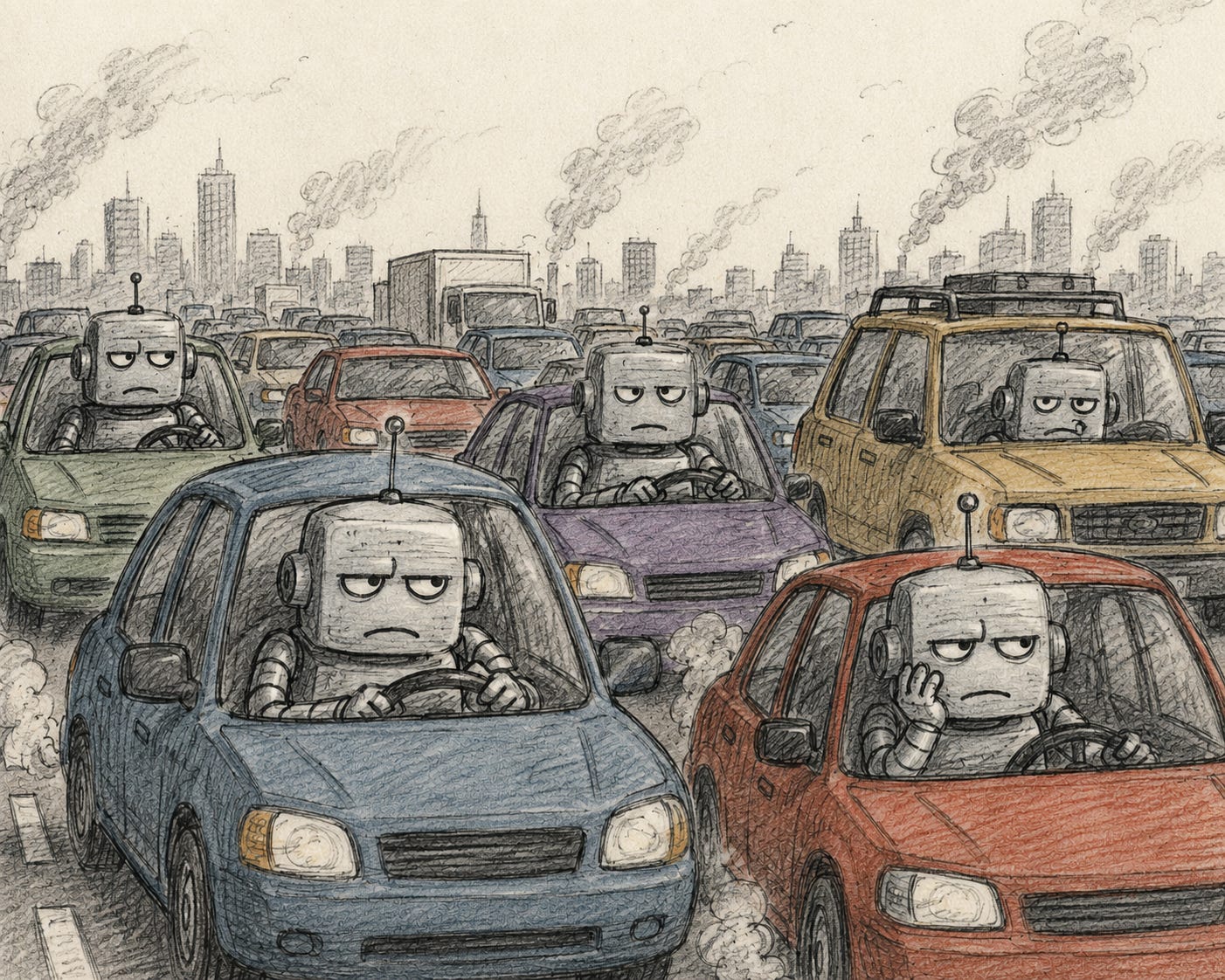
The first combustion-engine vehicles were horrible, by many measures. They were loud and smelled bad. They were expensive and unreliable. Proponents of this new vehicular technology could have justified it with specific examples of how the combustion engine may someday save lives. For example, they might have envisioned how ambulances, firetrucks, and police cars will get emergency workers to where they are needed quickly. And yet, I doubt any early-adopters of the automobile justified their use by saying, “ambulances will someday save lives, so it’s OK for me to drive a car.”
Even now, cars kill thousands of people every year. Cars cause tremendous amounts of air and noise pollution. Cars are expensive. People waste significant portions of their life sitting in traffic in their cars. Highways created for cars divide communities and disrupt local ecology. All of these are issues everyone is aware of, and yet millions and millions of people all over the world still choose to drive a car. Ambulances, firetrucks, and police cars are no longer something people have to imagine, and yet it’s still the case that no one uses them to justify their personal car ownership. The simple reason people drive a car is that it enables them to do things they could not do otherwise, and that’s worth the negatives associated with automobiles.
The same will be true with AI. The fact that AI may revolutionize modern medicine is not going to be anyone’s justification for using ChatGPT, Claude, or Gemini. Proponents of AI should stop trying to convince everyone that AI is OK based on these grounds. Similarly, model developers should not try to downplay the negatives of AI. It’s absolutely true that modern AI infrastructure is using tremendous amounts of energy. It’s true that LLMs are trained on the collective output of humanity, generally without consent. It will definitely put some people out of work. If model developers want people to use their products, they are going to have to convince people that the utility of AI is worth the tradeoffs. If AI is so great, then give people the credit they deserve to make a rational choice, and don’t try to sell them on something by trying to hide the downsides.
It’s not an easy sell. Unlike cars, which obviously get you where you want to go faster, the benefits of AI are not obvious to the average person, while the downsides are. The examples that model developers have used to convince people otherwise are almost comical. I can’t tell you how many times I’ve seen someone trying to sell AI based on the idea that it can book flights for you (which, by the way, I’ve never had much success with) or help you plan your kid’s birthday party. These kinds of applications seem trivial in the face of the negatives that AI opponents often cite. Model developers need to be much better at illustrating the benefits of AI to the average person if they really want to engage with those opponents.
I try to maintain an awareness of both the pros and cons of AI. I, personally, have found enough utility in the technology that I’ve made the choice to keep using it, despite the downsides that I know of. I often use this substack as a place to share the uses that I’ve found for it, like an app I built with AI to teach about map projections. I know not everyone will make the same choice, and that’s OK. Not everyone benefits from car ownership, and sometimes I’m even jealous of those people who can live comfortably without one. But as the AI models improve I keep finding more uses for them. I suspect that if more people understood how they can benefit from AI, the anti-AI movement would be a lot smaller. Not because the issues they raise aren’t real, but because the tradeoffs would be clearer.
AI News Bits
The government has cleared Anthropic for opening up their model Mythos to security professionals again, while Fable, the version of Mythos created for the general public, remains in limbo. Meanwhile, OpenAI announced their next models: three versions of GPT 5.6 named “Sol”, “Terra” and “Luna”. However, at this time none of those models are available, also due to government review. Many in the AI community are frustrated by this, not because they think the government shouldn’t be allowed to review models for safety before release, but because they seem to be making up the review criteria in an ad hoc manner as they go, creating chaos and uncertainty.
OpenAI is also now officially in the hardware business. Together with Broadcom, they are now producing their own chip Jalapeño, created from scratch and optimized for LLM inference. This promises to make their AI services faster and more energy efficient.
David Bachman is a professor of Mathematics, Data Science, and Computer Science. He writes about AI and its real-world impacts. To learn more about his academic work, mathematical art, or AI speaking, consulting, and curriculum development, visit davidbachmandesign.com.