
LLMs think in circles
A growing body of research hints at the complexity of the space of AI's thoughts

LLMs represent words as long lists of numbers, which we can think of as the coordinates of points in some abstract “representation space.” We’ve known for a while that points corresponding to related words can lie on lines in this space. Interestingly, researchers have recently discovered that they can lie on other shapes as well. For example, LLMs encode the days of the week on a circle, and this circular representation helps them answer questions such as, “What day is three days after Friday?” In other words, if you want to understand how LLMs work, it’s not enough to know how individual pieces of knowledge get encoded into numbers. You also need to know how those numbers fit together into shapes. This turns out to have surprising practical implications: it gives us a more refined way to reach into the “mind” of an LLM and control it from the inside, an important approach to AI safety called steering.
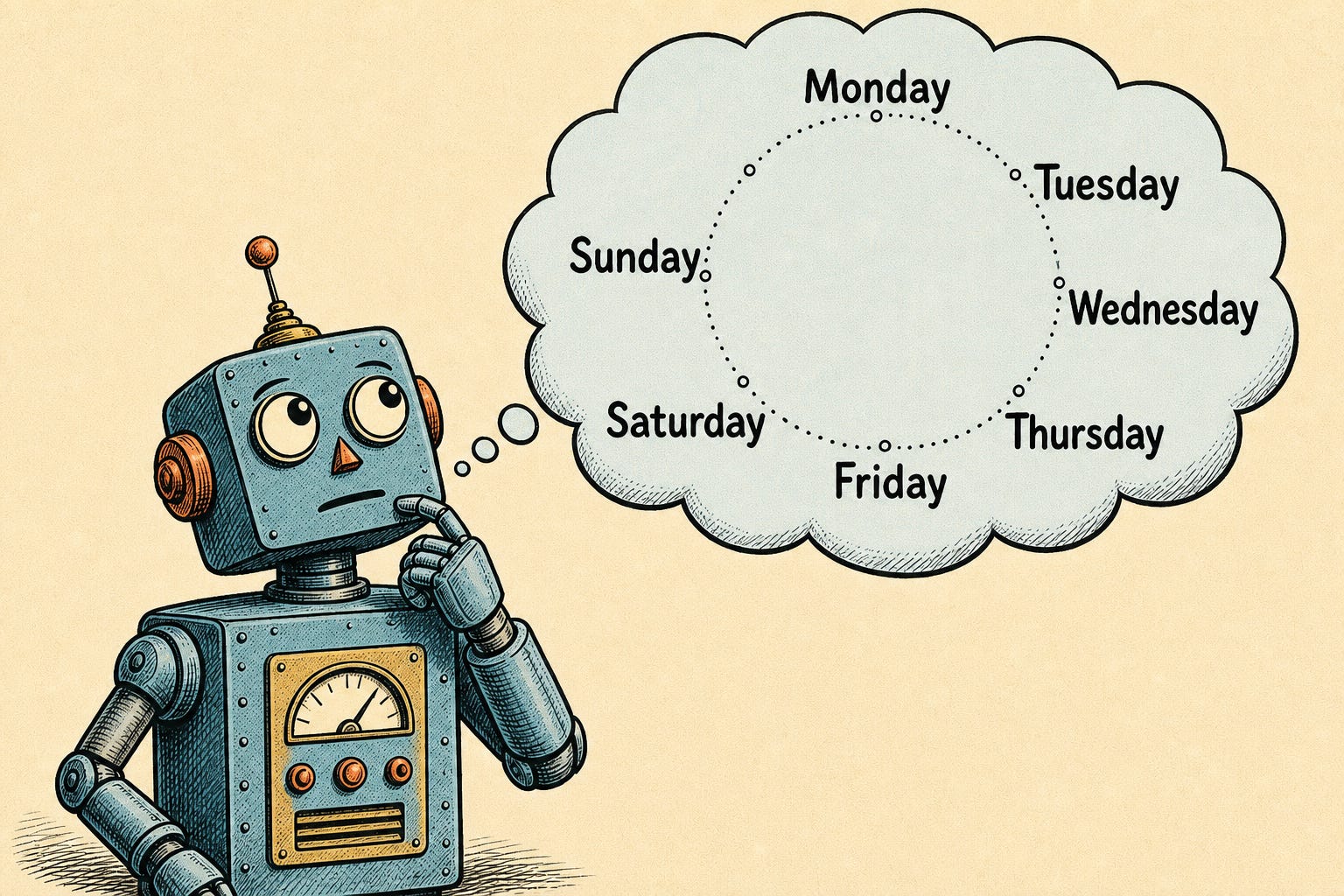
I became aware of this work by following my favorite AI company. No, not Anthropic, OpenAI, or even Google; it’s a much smaller lab focused on the field of “mechanistic interpretability” named Goodfire. This past May they began releasing a series of papers that they group together under the category “Neural Geometry.” These papers build on prior work that shows LLMs encode a wide variety of information along shapes other than lines. For example, days of the week and months get encoded by circles. Numbers get encoded by helices. More abstract concepts like emotions are represented on a two-dimensional “valence-arousal” plane.
If all we knew were that LLMs represent information as points on a non-linear shape, it would probably be just a curiosity; one of the many things we don’t understand about LLMs. But it turns out that in some instances these shapes are a key part of the way an LLM “thinks.” For example, Kantamneni and Tegmark showed that LLMs do simple arithmetic like adding two numbers by placing each on several circles that act like the faces of a clock, and then performing clock-like addition within each circle. Goodfire researchers showed this mechanism isn’t just limited to adding numbers. They studied the 8 billion parameter LLM Llama 3.1, and found that it uses the exact same mechanism (literally the same neurons!) to solve problems like “What month is sixteen months after August?” This is a significant finding. It demonstrates the existence of a general-purpose mechanism inside the “brain” of an LLM that is used for multiple related problems. That’s quite different from the common characterization of LLMs as machines that merely express statistical relationships.
Understanding how LLMs use shapes to represent information isn’t just about seeing how they record, or even manipulate, data. A well-established way to control LLM outputs is called steering. In this approach, researchers directly manipulate the numbers the LLM is processing deep within its internal layers of computation to influence the final words it produces. Goodfire researchers used the fact that these numbers represent points on curved spaces to help determine the right direction to steer them, leading to more effective control. That result cuts two ways. Practically, steering is an important approach to AI safety, and anything that makes it more precise matters. But it also addresses a potential criticism of the shape work: perhaps the fact that we “see” shapes in representation space is just an artifact of the way we’re choosing to connect the dots. The fact that you can reach into a model, move a point along a curve, and watch the answer change exactly as the curve predicts is a strong indication that this isn’t the case. The shapes are part of the machinery, not just part of our picture of it.
LLMs are trained to predict what comes next in a piece of text, based on statistical patterns in enormous amounts of data. In that sense, describing them as statistical machines isn’t wrong. But it is incomplete. It tells us how an LLM acquires its abilities, not what internal mechanisms emerge during training or how those mechanisms produce a particular answer.
Neural geometry gives us a glimpse of those mechanisms. LLMs don’t merely accumulate statistical associations; they organize information into structures and sometimes use (and reuse) those structures to compute. That gives us a richer picture of how LLMs work. It also gives us something rarer: a way to test our claims about what’s happening inside a model by intervening on it, and seeing whether it fails in exactly the way we predicted.
AI News Bits
OpenAI announced that during testing, an unreleased model escaped from a contained environment and conducted over 17,000 different actions to break into Hugging Face to steal the answers to a benchmark test. I find the most interesting part of the story to be the reaction from Hugging Face. They tried to use American frontier AI models to analyze the intrusion, but those models refused to comply due to their own safety restrictions. In the end, they had to rely on the open-weight Chinese model GLM 5.2 for assistance.
Anthropic backtracked on their announcement that access to their top model, Fable 5, will be restricted to pay-per-usage only, which would have been a first for a major frontier model. They’ve now granted access to those on plans costing at least $100/month.
Anthropic also released Opus 5 to mixed reviews. It does seem to be a step up from Opus 4.8, but less powerful than Fable. It is, however, open to subscribers at all levels. Comparisons with OpenAI’s GPT‑5.6 Sol vary considerably by task and benchmark.
David Bachman is a professor of Mathematics, Data Science, and Computer Science. He writes about AI and its real-world impacts. To learn more about his academic work, mathematical art, or AI speaking, consulting, and curriculum development, visit davidbachmandesign.com.