
An AI buyers guide
How to pick among the plethora of new model choices

Editorial note: You may have noticed that I’ve skipped the last few “App of the Week” posts. That’s because I’ve been in an intense phase of building more! I’ve been trying out a lot of different new models for that process, and much of this post is the result of those experiments. I’ll have a new app to share later this week, and its a good one!!
I try to write these posts so they stay relevant for at least six months. This one will be an exception. It’s a snapshot in time, most relevant on the day this post is released (July 14, 2026). I’m writing this now because within the last week there’s been a virtual firehose of new model releases, including offerings from OpenAI, Meta, and SpaceXAI. The week before we got Fable 5 from Anthropic (again), and not too long ago we got strong open models like GLM 5.2. Before all this I often got asked what model to use. For many, I know the choices are now completely overwhelming.
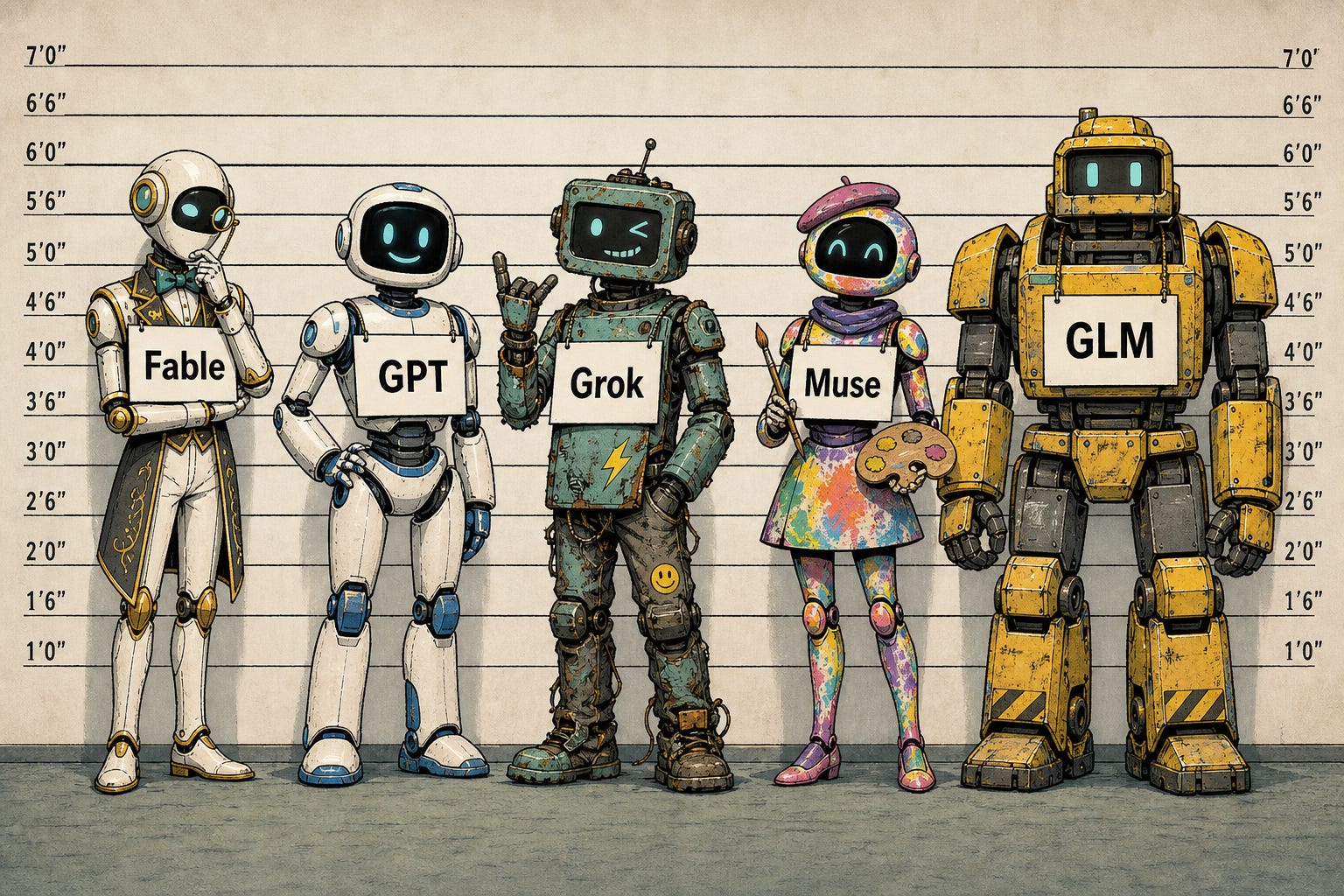
I suspect most people will just keep using whatever model is offered by the company they’re used to. The truth is, most just don’t need frontier levels of intelligence. However, people should at least be aware of what is out there, and what the current state of AI is. For those still shopping around, or who are willing to switch models based on cost or intelligence level, this post will be more relevant. People who track the industry may also want to know how each major lab is stacking up in the AI race. I have now done some fairly extensive testing of many of these models, and read countless reports of the others. Based on this experience, here’s where I believe the state of AI currently is.
In my experience, Anthropic’s Fable 5 is the most capable and most intelligent model currently available. I gave it some code written by GPT 5.5 and it really blew me away. Not only was it able to do some things that GPT 5.5 struggled with, but it also found (and fixed) many bugs and added some pretty amazing new features (which it also suggested). Unfortunately, Anthropic says Fable 5 will only available by purchasing pay-as-you-go credits, which can be extremely expensive, even for medium-sized projects. Right now you can access Fable with an Anthropic subscription, but they keep saying that subscriber access will end soon (although they’ve pushed back the date on that twice).
Last week OpenAI released their newest flagship model, GPT 5.6 “Sol”. By all accounts, it’s a significant step up from GPT 5.5. Many have expressed a preference for it over Fable 5 for incremental project improvements, and a preference for Fable 5 for big, autonomous updates and long-running tasks. The two frontier models just seem to be best at different kinds of tasks and workflows. Perhaps the single most important difference is that GPT 5.6 Sol is accessible with an OpenAI subscription, making it far more cost-effective than Fable 5. (The best available model from Anthropic via subscription continues to be Opus 4.8, which is roughly comparable to GPT 5.5.) My plan going forward is to use GPT 5.6 Sol as my workhorse for most projects, and then run almost-finished projects through Fable for final cleanup, bug fixes, etc. Later this week I’ll share a project I’ve been working on for months, for which I have now used GPT 5.4, GPT 5.5, GPT 5.6 Sol, and Fable 5.
At the next level down from Fable 5 and GPT 5.6 Sol are new models from SpaceXAI (Grok 4.5) and Meta’s Superintelligence Labs (Muse Spark 1.1). Both companies’ release materials report benchmark results comparable to GPT 5.5 and Opus 4.8, but significantly cheaper costs. I haven’t played with either, and I don’t expect they’ll make a huge dent in OpenAI or Anthropic’s consumer base. The real story here is that SpaceXAI and Meta are catching up faster than many (including me) had expected. Given the resources behind each company, we may see a day when the leading model comes from either of these companies, rather than OpenAI, Anthropic, or Google.
GLM 5.2 from Z.ai made waves a few weeks ago by being the first open model to rival the current frontier level of intelligence. However, that was before GPT 5.6 and Fable 5. For comparison, I’d put its intelligence level as around that of GPT 5.4 or Opus 4.7, which are now two generations old. That’s not bad for an open model! I’ve been playing with it hosted on National Research Platform servers, which eligible academic instructors can access for free. My impression is that it is indeed a very capable model, but due to its large size (744 billion parameters) it’s quite slow. However, the speed deficit is likely due more to the servers hosting it than to the model itself. (For free models hosted by nrp.ai, I found Qwen 3.6 “small” to be a better experience, even though GLM 5.2 did do a better job on the tasks I gave it.) Most who use GLM 5.2 will do it by purchasing API credits from Z.ai, and it is here where the previously mentioned releases from SpaceXAI and Meta become more interesting. Z.ai is a Chinese lab, and many will now opt for the newer models Grok 4.5 and Muse Spark 1.1 just because they are homegrown and comparable in cost.
Finally, many are wondering: “Where’s Google???” Google’s current flagship, Gemini 3.1 Pro, was released back in February. At the time it was competitive with the best models from OpenAI and Anthropic. My main complaint about it was that Google’s AI services were spread across so many platforms (e.g. Antigravity, Google Workspace, NotebookLM, etc.) that knowing when to use what feature could be confusing. For now, Google appears to have simply missed this round of model updates. However, I would not count it out for long.
In addition to the missing Google update, rumors are already swirling about GPT 6 and Fable 5.1 releases in just a few weeks, so stay tuned!
Other Releases
Alongside new models, we got a slew of other product announcements:
ChatGPT Work is OpenAI’s answer to Claude Cowork: an agentic platform for non-coding “work” tasks. From the online chatter I follow this created some confusion, as many wondered how this differs from asking GPT to do the same tasks through their Codex platform.
OpenAI combined their ChatGPT desktop app and their Codex coding app (along with their new ChatGPT Work platform) in an apparent move toward their rumored “superapp”.
At the same time, OpenAI announced that they were deprecating their Atlas browser, and added an integrated browser to their ChatGPT desktop app. (Atlas users who liked the side-by-side chat integration can still use Chrome with the ChatGPT plugin.) A few days later Anthropic also added a browser to Claude Code.
OpenAI also released their new voice model, GPT-Live. In my limited testing, it did seem like it was a much more natural conversational experience due to the fact that it can listen and speak at the same time.
Meta’s Superintelligence Labs released their AI image generation model, Muse Image. Within days, however, there was public backlash due to a controversial feature that allowed people to generate images by referencing anyone with a public Instagram account. Meta has since removed that feature.
In the same announcement Meta previewed Muse Video. They claimed its the third most preferred AI video generation model on “Text-to-Video Arena”, behind only Gemini Omni Flash and Seedance 2.0.
AI News Bits
Shortly after releasing GPT 5.6 Sol, a team from OpenAI announced that it proved a 50-year-old open problem in mathematics called the Cycle Double Cover Conjecture. OpenAI says the proof was machine-verified, but as of this writing it does not appear to have been independently verified by mathematicians.
The Department of Defense continues to push forward with their supply chain risk designation of Anthropic, even though the NSA (part of the DoD) has embraced Anthropic’s model Mythos for national security. The Air Force Research Laboratory has instructed affected contractors, including some academic institutions, to report their use of Anthropic products by August 1 and remove them from their systems by September 1.
David Bachman is a professor of Mathematics, Data Science, and Computer Science. He writes about AI and its real-world impacts. To learn more about his academic work, mathematical art, or AI speaking, consulting, and curriculum development, visit davidbachmandesign.com.