
AI Hype vs AI Hype Hype
AI hype is real, but AI hype hype has become its own genre.

One of the facets of modern life is that everyone exists in their own media bubbles. People of one political party can’t even understand how anyone can be in the other. The world seems similarly divided on AI. On the one hand there are those who work in fields like business, investing, consulting, and enterprise software. On the other are people in academic, artistic, educational, journalistic, labor, and socially critical circles. As an academic myself, I primarily interact with those in that second group. It is in those circles where I often notice something curious: frequent calls to resist AI hype, but not actually that much hype within those circles to resist.
The Merriam-Webster dictionary defines “hype” it as follows:
Hype: promotional publicity of an extravagant or contrived kind
To be clear, AI hype is real! If you’re in any area related to business you are probably subjected to frequent discussions of AI-fueled productivity miracles, adoption urgency, competitive inevitability, unprecedented ROI, huge market forecasts, and pressure to become “AI-first.” There really are companies making extravagant claims, vendors selling vaporware, and executives treating AI as a magic productivity machine. Some friends in the business world have told me they sometimes feel like AI is being forced down their throats, whether or not it’s good for their job or their company.
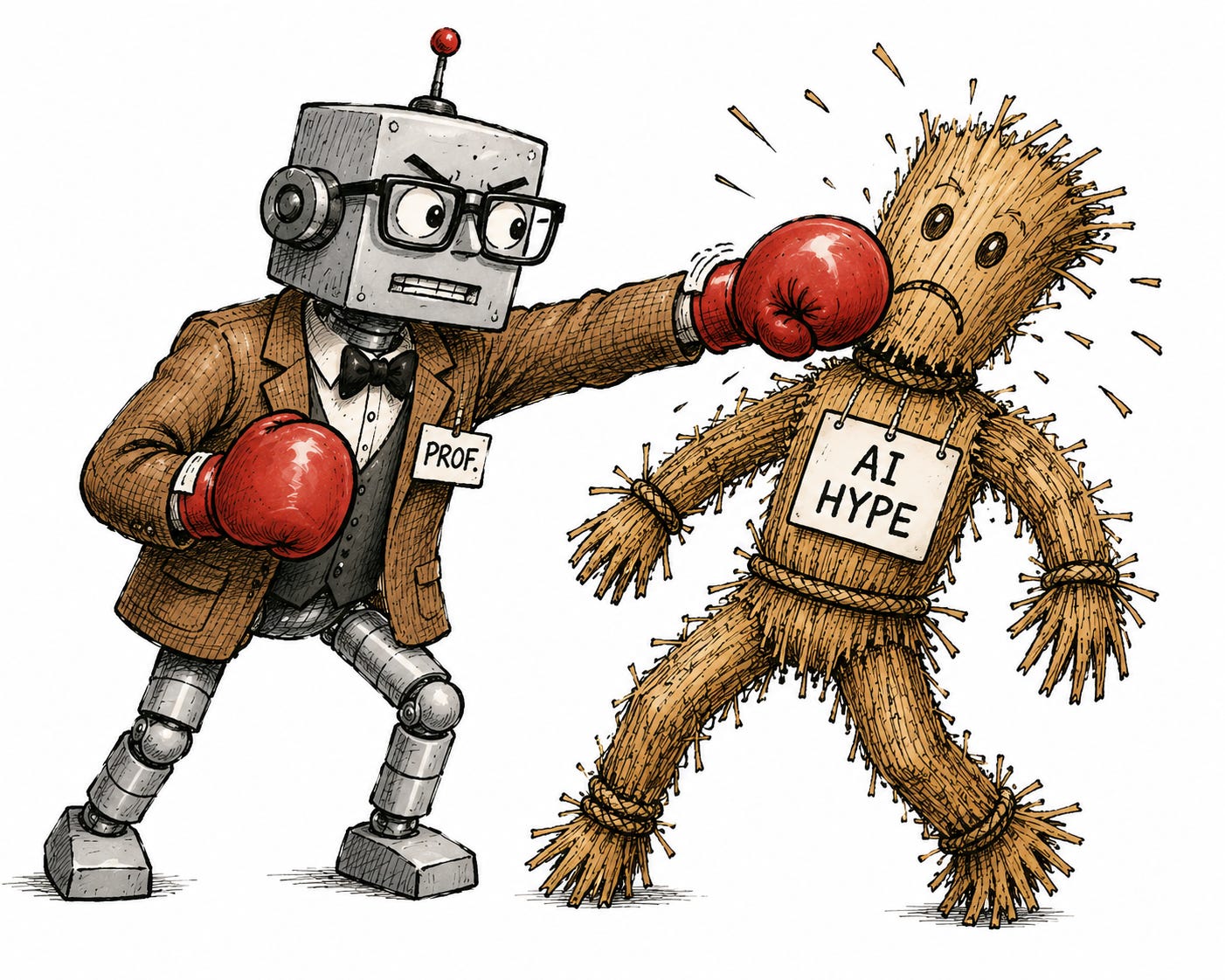
But in the circles where I spend most of my time, calls to resist AI hype are far more common than the hype they purport to resist. People in academia and the arts are generally not subjected to the same kinds of claims about AI as those in the business world. Instead, in countless blog posts, editorials, journals, and even major media outlets, you’ll hear academics focus more on the dangers of AI than you’ll hear about its promises, reflecting a generally skeptical view of AI by the American public. In those venues, calls to resist AI hype have become a frequent rallying cry; The specter of AI hype itself is now used as a kind of hype. That’s AI hype hype!
Some of the most visible AI commentary is not about AI itself, but about how to avoid being fooled by AI hype. These are often perfect examples of AI hype hype, and they’re not hard to find. Here are a few:
Arvind Narayanan and Sayash Kapoor’s book, AI Snake Oil, is built around “separating hype from reality.”
Emily Bender and Alex Hanna’s newsletter, Mystery AI Hype Theater 3000 and their book, The AI Con. Their newsletter promises to “break down the AI hype.” The book’s subtitle is “How to Fight Big Tech’s Hype and Create the Future We Want.”
John Warner’s 2023 Inside Higher Ed piece, Resisting the AI Hype Cycle in Education, is an education-specific example. It explicitly tells educators to resist the AI hype cycle, compares the moment to earlier ed-tech manias such as MOOCs, and warns against belief in a “teaching machine.”
The Washington Post’s 2024 article, The AI hype bubble is deflating. Now comes the hard part, is a perfect example of AI hype hype in mainstream media.
AlgorithmWatch’s UN AI regulation stance paper, Don’t fall for AI hype, literally warns, “If we do not resist AI hype and the techno-solutionist trap…” the result will be wasted resources and new problems.
To be clear, AI skepticism is not the same as resistance to AI hype. Many of the examples above contain valuable critiques of AI. However, their calls in particular to resist AI hype sound hollow to me, since I hear those calls much more than the hype they purport to resist.
AI hype hype is everywhere, if you look. At my college, I haven’t heard any administrators telling faculty that we must adopt AI or risk losing our jobs, like some in the business world are hearing. And yet, I’ve heard my colleagues talking about all the reasons why AI isn’t going to take their job, as if someone was telling them it was.
That’s not to say that there is zero pressure on academics to adopt AI-powered tools, go to seminars about teaching with AI, etc. However, are those things hype, or just academia struggling with the question of whether or not there can be real benefits to adopting this new technology? After all, not all promises made about AI are hype. AI really can do amazing things, for example, and I try to document examples of those things in this Substack. While AI has created significant problems in academia, its not hype to say there may be ways it can be beneficial, too.
This is why it’s so important to look critically at claims of AI hype. We absolutely need careful criticism and real debate about AI, but that requires asking which claims are actually being made, who is making them, and who is being asked to believe them. The next time you hear someone calling to resist AI hype, ask yourself: Is there a valid criticism of AI here, or is the author just using AI hype as a strawman to make their case? Is the author responding to a real claim, or to a convenient caricature?
Then again, maybe this post is just AI hype hype hype.
AI News Bits
Last week Anthropic came to a resolution with the US Government and re-released their industry-leading models Mythos 5 to security researchers, and Fable 5 to monthly subscribers on their Pro (and higher) plan. Access for the latter group was only temporary; on the day this post is released Fable will become available only by paying with API credits, which will presumably make it much more expensive. That’s understandable, as Anthropic serves these models at a significant loss, but it will be an adjustment for consumers desiring the highest levels of intelligence. This will be the first time the top model is not accessible through a monthly subscription plan.
David Bachman is a professor of Mathematics, Data Science, and Computer Science. He writes about AI and its real-world impacts. To learn more about his academic work, mathematical art, or AI speaking, consulting, and curriculum development, visit davidbachmandesign.com.